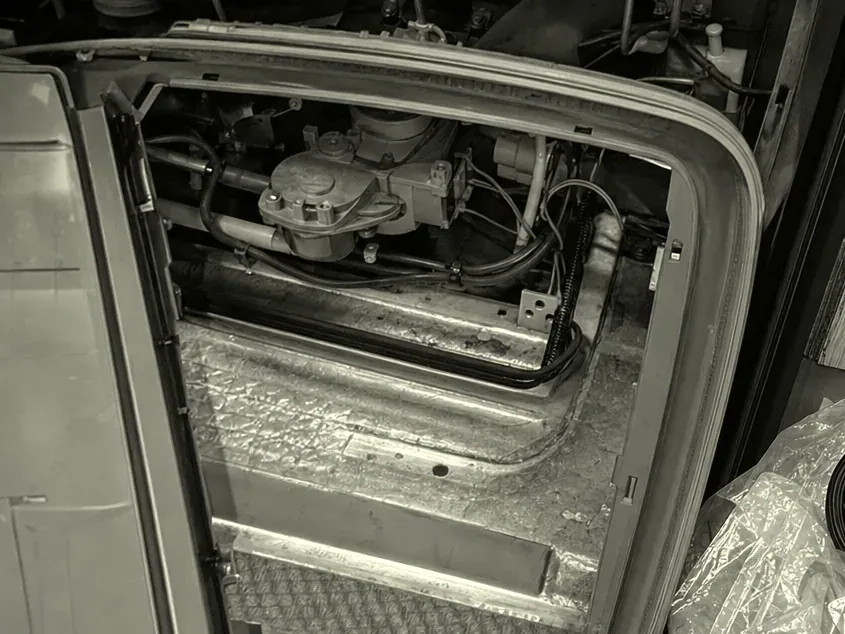
Most noises from a Sub-Zero ice maker are the sound of it working. A buzz or hum lasting a few seconds is the water valve refilling the tray, a soft motor whir followed by a clatter is a fresh batch of cubes being pushed into the bin, and a sharp crack is ice letting go of the mold. The sounds worth acting on are different: a valve that keeps buzzing while no water flows, grinding or repeated clicking at the ice maker, a fan that ticks or scrapes, and a compressor that knocks, clicks without starting or never seems to rest. A built-in Sub-Zero breathes through its front grille, so any change in its voice reaches the kitchen directly, and in a quiet house in The Canyons or in Castle Pines west of I-25 you will hear it.
The sounds a healthy ice maker makes
Every cycle follows the same pattern. The valve opens for several seconds and you hear a hum, sometimes with a trickle as the tray fills. Then the unit goes quiet while the water freezes. When the cubes are ready, the mold warms just enough to free them, which can produce a crack or two, and the ejector turns with a low whir and drops the batch. That drop is loudest when the bin is nearly empty, because the cubes land on bare plastic instead of a pile of ice.
Max Ice changes the rhythm. On Classic (CL) and Designer (DET, DEC) units it lifts ice production by up to 30% for 24 hours, and Sub-Zero notes that some parts may run faster and sound different while it is active. On many displays, including the IW-30CI, one ice cube icon means the ice maker is on and three ice cubes mean Max Ice is running, so glance at the panel before assuming something has gone wrong.
Pulling the bin also pauses things. On Classic (CL) and Designer (DET, DEC) models there is a 3-minute delay after the bin comes out before the ice maker carries on, and if the bin will stay out for a long stretch Sub-Zero advises switching the ice maker off.
Fan and compressor sounds that get blamed on the ice maker
A good share of what sounds like the ice maker is really the refrigeration system around it. The compressor hums steadily while it runs. Refrigerant can gurgle or hiss for a minute after it stops, and the evaporator fan moves air with a soft rush. During a defrost you may hear a faint sizzle as meltwater meets the warm heater. None of these is a fault.
Now the faults. A ticking or scraping that rises and falls with the fan usually means a blade is brushing against frost, a wire or a loose cover, and frost on the fan points back to a defrost problem. A squeal that grows louder over a few weeks is often a fan motor bearing wearing out. A compressor that bangs as it starts or stops, clicks every few minutes without starting, or runs without a break while sections feel warm needs a technician rather than a wait-and-see approach.
The condenser has a lot to do with how hard all of this works. Sub-Zero advises a cleaning once or twice a year, and sooner than that where a dog or cat sheds, taking care not to bend the aluminum fins. Brush and vacuum only: chemical condenser cleaners are not needed and Sub-Zero does not recommend them. A clogged coil makes the compressor and condenser fan run longer and louder, which plenty of owners mistake for an ice maker problem.
Ice maker noises that point to a fault
A buzz with no water. If the valve hums for longer than a few seconds and you hear nothing filling, it is energized but starved. The usual causes are a closed shutoff, a kinked line, a clogged filter or a frozen fill tube. Turn the ice maker off until the supply is sorted, since a valve buzzing against an empty line does it no good.
Grinding or repeated clicking. The ejector may be stalled against a cube that froze into the mold, or cubes may have clumped and jammed the bin. Empty the bin, break up any clump and let the next cycle run. If the grinding returns, the ice maker motor or module is likely failing.
Spitting, hissing or uneven cubes after a filter change. That is air in the line. Once a fresh filter goes in, Sub-Zero says the Classic (CL) and Designer (DET, DEC) units that lack a dispenser need two complete bins made and dumped, while those with a dispenser should pour water for two minutes. The noise fades once the air is out.
A bang from the pipes as the valve shuts. That is water hammer, a supply-side issue rather than a refrigerator fault, and a plumber can fit an arrestor on the line.
If your ice suddenly tastes or looks different around late spring, read our note on the May water switch in Castle Pines. A change in supply is a sensible moment to check how old the filter is. On Classic (CL) and Designer (DET, DEC) touch controls, Snooze/Refresh appears when the filter is due, and Snooze pushes the reminder back 24 hours.
Leaks, a flashing ice cube and getting it to restart
Leaks are the question homeowners search for most on this topic. Water under the unit usually traces to a valve that does not close fully, a loose or cracked supply connection at the back, or a tray that overfills, drips and freezes into a lump. Shut the supply, dry the floor and check whatever connection you can reach.
Classic units carry a built-in safeguard. When a single ice cube icon flashes without an alarm, the fill valve was held open longer than it should have been, so the board shut the ice maker off rather than risk a flood. Check that water is reaching the unit, then press and hold the Alarm key until CFC (Clear Fault Codes) shows on the display. If the icon comes back, the valve or supply line needs replacing, not another reset.
A silent ice maker that has stopped producing might simply be in Sabbath Mode. It turns the ice maker and the door alarm off and keeps them off, and the refrigerator returns to Sabbath Mode after a power cut. 500 Series units and the UC-15I have no Sabbath Mode at all.
The UC-15I undercounter ice maker
The UC-15I is a different machine with different sounds. It can store up to 25 lb of ice and make up to 50 lb per day, and it uses about 1 gallon of water per hour, so a steady sound of running water during production is normal.
If it runs but makes no ice, Sub-Zero says to confirm water pressure between 20 psi (1.4 bar) and 80 psi (5.5 bar) and room air of 50°F to 100°F for the indoor model. An indoor unit fitted in an unheated garage or bar area can fall below that during a Castle Pines winter. The condenser sits behind the kickplate and should be cleaned every six months; a dusty one makes the unit noisier and slower. The DELAY key pauses production for 2, 4 or 8 hours if the sound is unwelcome at night.
What to check before you call
- Look at the display for the ice cube icons, Max Ice or Sabbath Mode.
- Confirm the water shutoff is open and the line behind the unit is not kinked.
- Empty the bin and clear any clumped ice.
- Note when the noise happens: during the fill, during the harvest, or along with the fan and compressor.
- Clean the condenser if it has been more than a year.
If the noise is still there, call (720) 807-8323 or use the booking button on this page; our page on Sub-Zero refrigerator repair in Castle Pines explains what a visit includes. The $89 visit fee covers the drive out and the diagnosis, and that $89 is subtracted from the invoice once you approve the work. As typical figures before the firm quote that follows diagnosis: an ice maker, water valve or supply line repair runs $300–$840, an evaporator or condenser fan motor $340–$730, and compressor or sealed-system work $1,340–$3,030.
Questions, briefly
Is it normal for a Sub-Zero ice maker to buzz?
Yes, a buzz or hum of a few seconds each cycle is the water valve opening to refill the tray. It becomes a problem when the buzz runs on with no sound of water, which usually means the supply is shut, kinked or blocked. Switch the ice maker off until water reaches it again.
How do I reset my Sub-Zero ice maker?
On a Classic model showing one flashing ice cube with no alarm, check the water supply first, then press and hold the Alarm key until CFC appears to clear the fault. That flashing icon means the valve stayed open too long and the ice maker shut itself off to avoid a flood. If it trips again, the valve or supply needs a technician.
Why is my Sub-Zero ice maker leaking water?
A leak from the ice maker usually comes from a water valve that does not close fully, a loose or cracked supply connection behind the unit, or a tray that overfills, drips and freezes. Shut the water off at the supply valve, dry the floor, and look at the connection behind the refrigerator before booking a visit.
How do I clean a Sub-Zero ice maker?
For the UC-15I undercounter ice maker, touch CLEAN, empty the bin, wait for the light to blink before adding 4 ounces (115 ml) of cleaner, and follow with a second cycle using 1 tablespoon (15 ml) of sanitizer. Each cycle takes about 30 minutes and cannot be canceled once started. Sub-Zero suggests doing this every six months.
Why is my Sub-Zero not making ice?
The usual reasons are simple: the ice maker is switched off, Sabbath Mode is on, the bin was just pulled out, or the water supply is closed. Sabbath Mode shuts the ice maker down and comes back on by itself after a power failure. If none of those apply, the valve, the ice maker module or the controls may be at fault.