Most of these machines live on your water line
Three of the appliances on this page draw from the house supply: the dishwasher, the washer, and the ice maker and dispenser in a refrigerator. The fourth, the dryer, is there to get that water back out of your clothes. That is why so many of the faults below begin with water: a fill that never finishes, a puddle on the floor, a drain that quits, a load that comes out damp.
West of I-25 the water itself changes twice a year. From May to September, Castle Pines North Metropolitan District pumps its own wells in the Arapahoe, Denver and Lower Dawson aquifers; from October to April it delivers water stored in Chatfield Reservoir and treated by Centennial Water and Sanitation District. The district publishes no hardness figure for either supply, so we quote none. In The Canyons, east of the interstate, the water comes from Parker Water and Sanitation District.
A new supply can bring film on glassware, ice with a new taste, or a softener setting that suited one water and not the other. Those are settings, not broken parts, and we will tell you so. Miele says its built-in softener begins treating water above 5 gpg and copes with up to 73 gpg; on any dishwasher with a softener, a test strip after each switch is cheaper than a service call.
Dishwashers, whatever the badge
- Water still in the tub
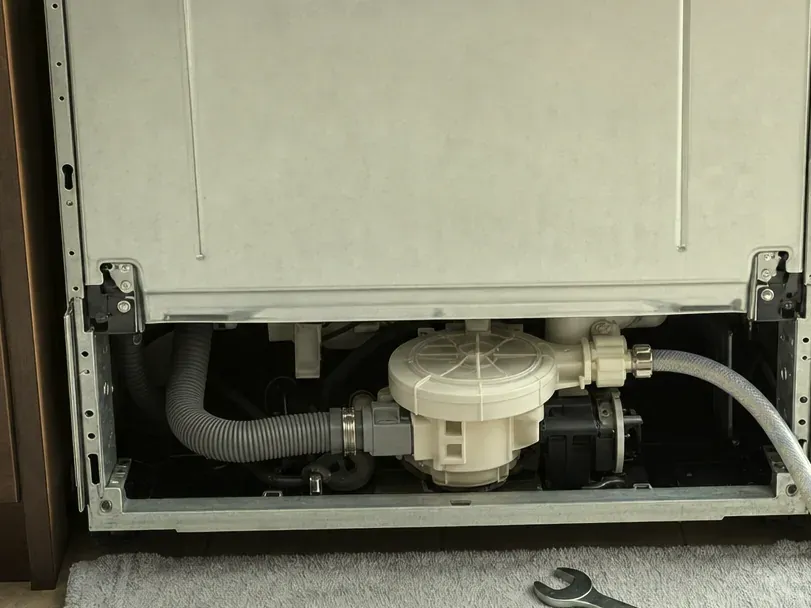
Whirlpool and KitchenAid show F9E1 for a long drain and send you to the same places we look first: the filter, the drain hose, the disposer and its knockout plug, the air gap.
- No water coming in
On KitchenAid and Maytag, H2O means the machine detects no water. An open supply valve and a hose without kinks come first; the inlet valve itself comes after.
- Water in the base
Bosch shows E15 once water reaches the base and its leak protection trips. Shut off the water to the dishwasher; then the leak has to be traced, to a hose, a pump seal or the door.
Washers: hoses, screens and the drain
A washer fills through two hoses that hang behind it for years without anyone looking. GE Appliances recommends replacing those inlet hoses every 5 years, and straight away if one shows a bulge, a cut or corrosion. Speed Queen asks owners to look at the small filter screens in the fill hoses every six months. When the screens clog, filling slows or stops, and the display says so: Samsung shows 4C, 4E or nF, LG shows IE. When the water cannot get out, LG shows OE, most often from a kinked drain hose or a clogged pump filter. Past those checks we replace valves, pumps, door boots, lid locks and suspension parts.
Dryers: the vent decides
A dryer that needs two cycles is usually short of air rather than broken. Whirlpool and Maytag dryers show AF or F4E3 when lint or a crushed duct restricts the airflow, and Whirlpool wants the outside vent cleaned every one to two years, or sooner once drying slows down. LG dryers estimate the blockage for you: d75, d80, d90 and d95 mean the duct is that far clogged, in percent. If the vent is clear and the drum still tumbles cool, the fault is in the heating circuit or in the sensor that judges when the load is dry, and that is a repair.
Fridges and ice makers of other brands
Sub-Zero has its own refrigerator repair page, with price ranges. A GE, LG, Samsung, Whirlpool, KitchenAid or Frigidaire refrigerator gets the same method: section temperatures measured, fans and defrost parts tested, the sealed system checked last. Ice is mostly about cold and water pressure. Whirlpool asks for a freezer between 0 and 5°F, the water valve fully open and a line without kinks; Samsung needs at least 20 psi at the ice maker and warns that a reverse osmosis system can pull the pressure below that.
The visit and the bill
One fee for any machine: $89. It pays for the drive and for finding the fault, and it is credited to the repair if you go ahead. Sub-Zero repairs have published ranges on this site; other brands do not, because parts differ too much from one model to the next. You hear the figure once the cause is known, and nothing is replaced until you agree. Someone picks up the phone 24/7, and a technician can be at your door between 8 am and 8 pm on any day of the week.
Before you book
Can the water switch be the whole problem?
Sometimes it is. When film appears on glasses or the ice starts to taste different in May or October, yet every machine still fills, drains and finishes its cycle, look at settings and water first: a test strip, the softener setting where there is one, the rinse aid, a fresh refrigerator filter. A machine that stops filling or stops draining has a fault, whatever the month.
Should I turn the water off before you arrive?
Only if something is leaking. A dishwasher is usually fed from a valve under the kitchen sink, a washer from the two taps behind it, and a refrigerator line from a small valve near the sink or in the basement. If nothing is leaking, leave it all connected, because watching the machine fill is part of the diagnosis.
Do you come to The Canyons as well?
Yes. We work on both sides of I-25: the original city to the west and The Canyons to the east. The visit is $89 either way, and The Canyons is not on the seasonal switch described above.
Sources
- Castle Pines North Metropolitan District, 2024 Water Quality Report (data for 2023)
- Colorado Politics, "Tapped: Castle Pines upgrading water treatment capacity for future need" (24 May 2026)
- Miele, Operating Instructions Dishwashers (en-US)
- Whirlpool Product Help, "F9E1 - Dishwasher"
- KitchenAid Product Help, "H2O - Dishwasher"
- Bosch, "E15 Bosch Dishwasher Error Code"
- GE Appliances, Front Load Washers Owner’s Manual (49-3000368)
- Speed Queen, User’s Guide for Topload Washers (204807)
- Samsung, washing machine information and error codes
- LG, Front Load Washer error code list
- Whirlpool Product Help, "Error Codes in Dryers"
- Whirlpool Product Help, "Check Vent Light on Dryer"
- LG, Dryer error code list
- Whirlpool Product Help, "Ice Maker Not Working"
- Samsung, "Samsung ice maker is not working"